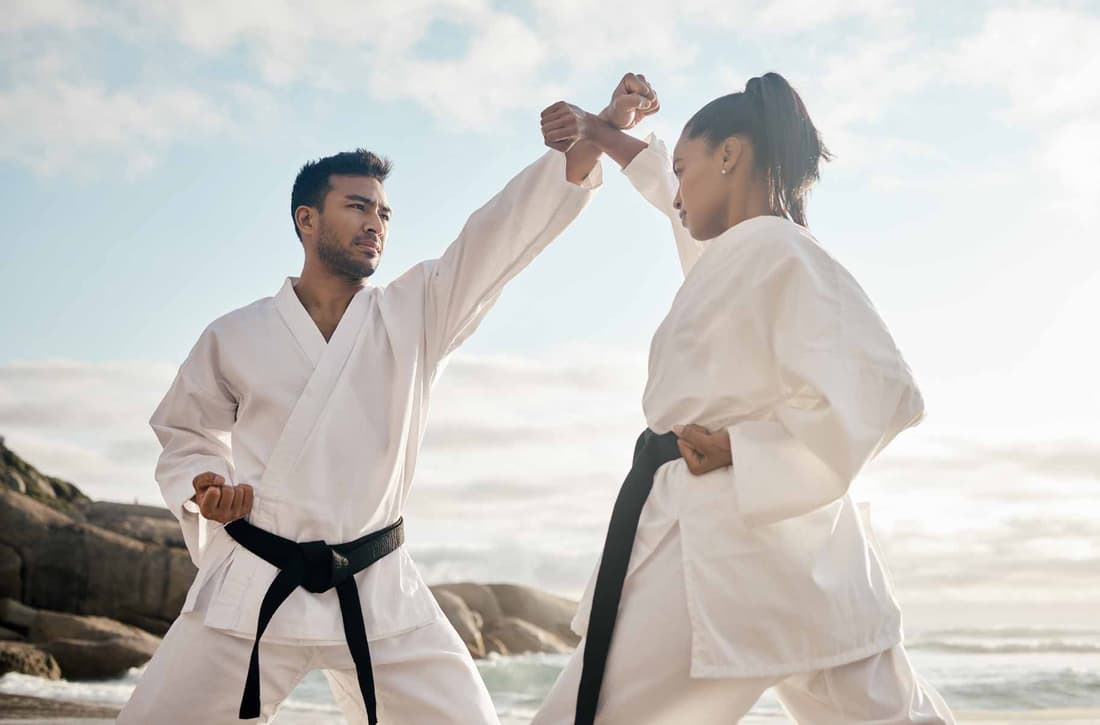
Two karateka in white gi and black belts training on a beach, one blocking the other's strike, bright sky behind

Why train here.

Plenty of places will teach a child to punch. Fewer care as much about when not to. Here's what makes this dojo different, and why the difference is the whole point.

Why this dojo

  1. Discipline, without intimidation.

    Nothing here is taught through fear, shouting or humiliation. Discipline means attention, effort and good manners, and that's all it means. A child learns to defend themselves and, in the same breath, learns why they almost certainly never will have to.

  2. A real lineage, not a franchise.

    We teach in Gichin Funakoshi's line, and we carry his name. Every grading awarded at Broadlands carries the authority of Hanshi Selvan Govender, an 8th Dan black belt who heads the Association of Funakoshi Shotokan Karate SA.

  3. It shows up outside the dojo first.

    Children who train in karate are much less likely to be bullied, or to become bullies. Parents usually tell us the change lands at school before it lands anywhere else: sharper focus, better decisions, and the confidence to say no.

  4. One small class, one teacher.

    The Monday class at Dream Padel Broadlands is run by Sensei Saveshan Naidoo. He's the one your child actually trains under, week after week, so nobody gets lost at the back of a hall.

  5. Watch before you commit.

    No booking, no pressure, nothing to pay. Turn up on a Monday evening, stand at the side of the mat, and decide for yourself. If it's not for you, you've lost an hour.

Who trains here

Three ways in, one mat.

Whatever brought you here, you start with the same white belt and the same first lesson.

Dojo

Children's Karate

Confidence, focus and self-defence, taught without fear, shouting or humiliation.

Children who train in karate are much less likely to be bullied, or to become bullies, because they build genuine confidence and real respect for other people.

That is the whole point of how we teach. A child learns to defend themselves and, in the same breath, learns why they almost certainly never will have to. Discipline here means attention, effort and good manners. It does not mean intimidation.

Training builds self-control, better decisions, teamwork, and the self-esteem to say no. No to a bully, no to drugs, no to whoever is pushing. Parents usually tell us the change shows up at school before it shows up anywhere else.

Discipline

Adult Karate

Traditional Shotokan for adults. Beginners welcome, no experience needed.

Shotokan karate in the Funakoshi tradition: kihon (fundamentals), kata (form) and kumite (sparring), trained with precision and patience.

You do not need to be fit, flexible or young to start. You need to turn up. Progress is measured against the person you were last month, and marked through the grading system of the Association of Funakoshi Shotokan Karate SA.

Practice

Self-Defence

Practical skills to protect yourself and others, plus the judgement to know when not to.

The knowledge and skills to defend yourself or someone else, and to stand up to bullies.

Karate begins and ends with courtesy. Funakoshi's fifth precept is blunt about it: refrain from violent behaviour. So we teach the capability, and we teach the restraint that makes it safe to carry around. The second part is the harder lesson, and it is the one that matters.

Common questions

The things parents ask us most.

A few of the questions we hear most often. There are plenty more on the FAQ page.

  • No, karate reduces aggression rather than causing it. Traditional Shotokan training is built on discipline, respect and self-control, and children are taught that their karate may only ever be used in self-defence. Our motto at AFSKSA Broadlands is "Discipline, Without Intimidation". Most parents notice their child becomes calmer, more focused and better at managing frustration.

  • Yes, karate helps bullied children primarily by building the confidence and self-esteem that make them less likely targets. Children also learn awareness, verbal boundary-setting and age-appropriate self-defence, always with the emphasis on avoiding conflict. Instructors encourage children to speak to parents and teachers about bullying rather than settle it physically.

  • Yes, the structure, routine and physical outlet of karate suit high-energy children very well. Classes follow clear, repeated patterns with immediate feedback, and children earn visible progress through the belt system, which keeps them motivated. Many parents report improved concentration and self-regulation at school after a few months of training.

  • Yes, karate is one of the safer and more controlled physical activities for children when it is taught by a qualified instructor. Techniques are taught progressively, contact is strictly controlled and supervised, and classes at AFSKSA Broadlands run under the syllabus and safety standards of the Association of Funakoshi Shotokan Karate SA.

  • Karate teaches children discipline, respect, perseverance, focus and confidence. The dojo reinforces goal-setting through the belt system, courtesy through etiquette, and resilience through gradual challenge. These habits carry over into schoolwork, sport and home life, which is why so many parents choose karate over other activities.

  • Yes, shy children often thrive in karate precisely because the environment is structured and predictable. There is no pressure to perform in front of others early on. Children progress at their own pace and build confidence through small, repeated successes. Many formerly shy students grow into the most confident members of the dojo.

The honest answer is to come and see for yourself.

One Monday, one hour, on the side of the mat. No booking, and nothing to pay.

WhatsApp